Watercolor Moon Phases Clipart
A Designer’s First Look: Soft, Dreamy—But Will It Stitch Cleanly?
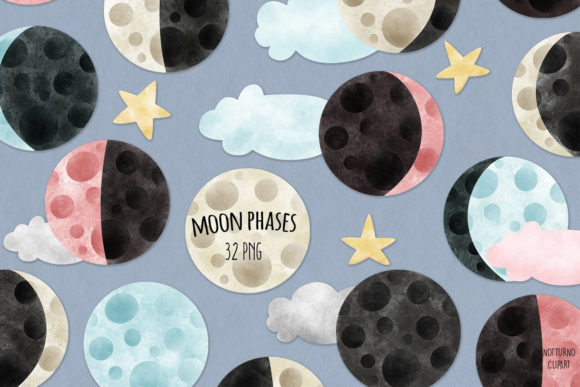
Opening the Watercolor Moon Phases Clipart set, I felt that familiar quiet pull—the kind you get when a design whispers “nursery wall,” “midnight baby shower invite,” or “hand-stitched pillow for a stargazing teen.” The 32 images are delicate, painterly, and intentionally imperfect: soft edges, subtle pigment bleed, gentle gradients between crescent, gibbous, and full. There’s no hard line work, no crisp vector geometry—just layered watercolor washes in muted blues, lavenders, greys, and warm off-whites. As an embroidery designer who’s stitched everything from dense floral motifs to minimalist monograms, my first question wasn’t “Is it pretty?” (it is), but “What happens when this becomes thread on fabric?”
Where This Clipart Truly Shines—And Where It Needs Careful Translation
I tested the concept on a real project: a custom embroidered cotton twill tote bag for a local boutique’s “Celestial Summer” collection. The client wanted something serene but not childish—elegant enough for a yoga studio gift, grounded enough for daily use. I chose one of the larger, more defined moon phases (a softly textured full moon with faint halo) and converted it into a machine embroidery design using a balanced mix of satin stitch for outer curves and low-density fill stitch for the inner wash effect.
The result? A finished product that read as *hand-painted*, not digitized. Customers paused at the display rack—not because it shouted, but because it invited quiet attention. That’s the strength of Watercolor Moon Phases Clipart: it brings mood and intentionality to handmade products without needing embellishment. It works beautifully for:
- Baby embroidery — especially on organic cotton onesies, swaddles, and crib mobiles where softness matters more than sharp detail
- Nursery decor — pillow covers, tea towels, framed hoop art, and blanket edging
- Personalized gifts — sweatshirt embroidery for teens, aprons for astrology-loving bakers, or cap patches for small shop merch
- Craft business assets — printable mockups for Etsy sellers, digital product previews, and boutique branding elements
Real Embroidery Considerations: What You’ll Need to Adapt
Let’s be clear: Watercolor Moon Phases Clipart is a graphic set—not a ready-to-stitch embroidery file. That means every element must be digitized thoughtfully. Its watercolor nature doesn’t translate directly to thread. Here’s what I watched for:
- Stitch density — Too much fill stitch kills the airy feel. I reduced density by 25% in mid-tone areas and used running stitch accents to suggest texture instead of heavy coverage.
- Hoop size & detail scale — Smaller moons (under 2.5”) lost definition in satin stitch. I reserved those for applique designs or larger-format projects like wall hangings—not tiny embroidered patches.
- Fabric texture & stability — On slubbed linen or loosely woven tea towels, the soft edges blurred further. I added light tear-away stabilizer underneath and avoided high-contrast thread colors that would fight the subtlety.
- Dark vs. light backgrounds — The clipart’s pale palette reads beautifully on ivory or oat-colored fabrics—but fades on charcoal or navy unless you adjust thread values or add subtle underlay stitching.
Where to Use It Thoughtfully—Not Just Conveniently
This isn’t a go-to for high-detail commercial embroidery jobs like corporate logo patches or performance-wear sweatshirts. Avoid pushing Watercolor Moon Phases Clipart into contexts where clarity trumps atmosphere:
- Small hoop sizes (<2”) on curved surfaces like caps or baby beanies
- Thin or stretchy fabrics (jersey, rayon blends) without proper cut-away stabilizer
- Dense layered garments (like quilted jackets) where stitch buildup could distort the watercolor illusion
- Products requiring frequent washing—unless you test thread colorfastness and stitch anchoring first
It also doesn’t carry built-in lettering or borders, so pairing it with typography requires extra layout judgment. Don’t assume “printable clipart” means “plug-and-play embroidery file.”
Design Integrity Meets Customer Trust
As an Etsy seller and small shop product developer, I know customers don’t just buy a moon—they buy *intention*. When someone chooses a watercolor moon for their baby’s onesie, they’re choosing calm, wonder, quiet growth. That emotional resonance carries through only if the finished product feels cohesive and considered. A poorly digitized version—with jagged edges, muddy fills, or mismatched thread tones—breaks that trust. But done well, Watercolor Moon Phases Clipart elevates a simple tote bag into a keepsake, a plain pillow cover into a curated moment.
Practical Notes Every Embroidery Designer Should Run Through
Before committing to a client project or bulk production:
- Test on scrap fabric first — especially your target fabric type and color
- Check thread color contrast — try both tonal (e.g., slate grey on charcoal) and complementary (lavender on oat) options
- Review stitch density — high density flattens watercolor nuance; aim for breathability
- Confirm licensing — since this is labeled as printable clipart for card making and scrapbooking, verify commercial embroidery rights before selling finished items or digital embroidery files
- Use proper stabilizer — lightweight cut-away for stable wovens, tear-away + topping for textured surfaces
- Compare black-and-white mockups — ensures value shifts read clearly without color crutches
Final Thought: Mood Over Mechanics
Watercolor Moon Phases Clipart won’t win awards for technical precision—and it’s not meant to. Its value lies in its ability to soften a product’s voice, deepen its story, and connect with buyers who seek meaning over mass. For embroidery designers building intentional brands—whether for baby shops, mindful apparel lines, or celestial-themed craft fairs—this set is less of a “design asset” and more of a quiet collaborator. Handle it with care, digitize with restraint, and let the watercolor spirit guide the stitch—not the other way around.